Digital Transformation
Digital Transformation in Banking: What Customers Expect and How to Modernize Bank Apps
- Published
- Reading Time
- 6 min
- Topics
- Digital Transformation
Customers now expect to open an account in minutes, send money in a few taps, and apply for a loan without a stack of paperwork. Corporate clients want payments and liquidity managed from one place.
This article looks at those expectations, how banks can modernize the apps on top of their existing core banking systems, and lessons from e-KYC onboarding, corporate banking, loan automation and 24×7 operations projects.
Customer expectations have changed
Today's customers don't just compare your banking app with other banks' apps. They compare it with every app they use daily: online shopping, ride-hailing, digital wallets. If buying something takes a few taps, they wonder why opening an account or sending money should be harder.
For product, digital and IT teams at banks, this shifts how success is measured. A long feature list is no longer enough. What customers judge is how fast, clear and reliable a process is from start to finish.
Retail customers
- Fully digital account opening. Customers want to open an account from their phone without visiting a branch, with identity verification that runs automatically.
- Simple transfers. As few steps as possible, with clear confirmation so customers are confident their money reached the right recipient.
- Fast but secure login. Authentication that isn't a hassle, without compromising security.
- Connected payments. QRIS, digital wallets and bills, all reachable from one app.
Corporate clients
Corporate clients have more complex expectations. Corporate treasurers and finance teams need control over liquidity, multiple payment channels in one place, and approval workflows that match their organizational structure. They also want services such as loans, FX, trade finance and payroll to be requested and tracked digitally, not through stacks of paperwork and branch visits.
Lending processes
On the credit side, customers want a clear application and a status they can track. Inside the bank, analysts, approvers and operations teams need one shared workflow so documents don't bounce around through email and spreadsheets.
Modernizing the apps on top of your core banking system
Many banks face the same dilemma: the existing core banking system is stable and serves as the source of truth for data, but the applications on top of it feel slow to evolve. Replacing the core is often not a realistic option in the near term. The good news is that customer experience is largely shaped by the application and integration layer, not by the core itself.
A common, practical approach is to build new applications that connect to the core and to supporting services through APIs. A few principles help:
- Separate the user experience from the core. Web, mobile and tablet apps talk to the core through an API layer. That way, screens and flows can be updated without changing the core.
- Use dedicated services for dedicated functions. ID document OCR, liveness checks and AML screening can be connected as separate services through APIs, so each can be replaced or upgraded without tearing the app apart.
- Start with the most-used customer journeys. Account opening, login and transfers usually have the biggest impact on how customers perceive the bank. Fix these flows before adding new features.
- Design for multiple roles. Internal applications, such as a lending system, are used by many roles with different needs. Access rights and screens should adapt to those roles.
- Plan operations from day one. Digital services run around the clock. System monitoring and incident-handling procedures should be planned alongside development, not after launch.
The implementation principles we follow are simple: as standard as possible, delivered as fast as possible, and affordable. The more standard the components and integration patterns, the easier it is for the bank's own team to maintain and extend the application.
Lessons from real projects
Digital Center Indonesia has delivered digital projects for more than 15 banking clients. Here are four examples that illustrate the approach above.
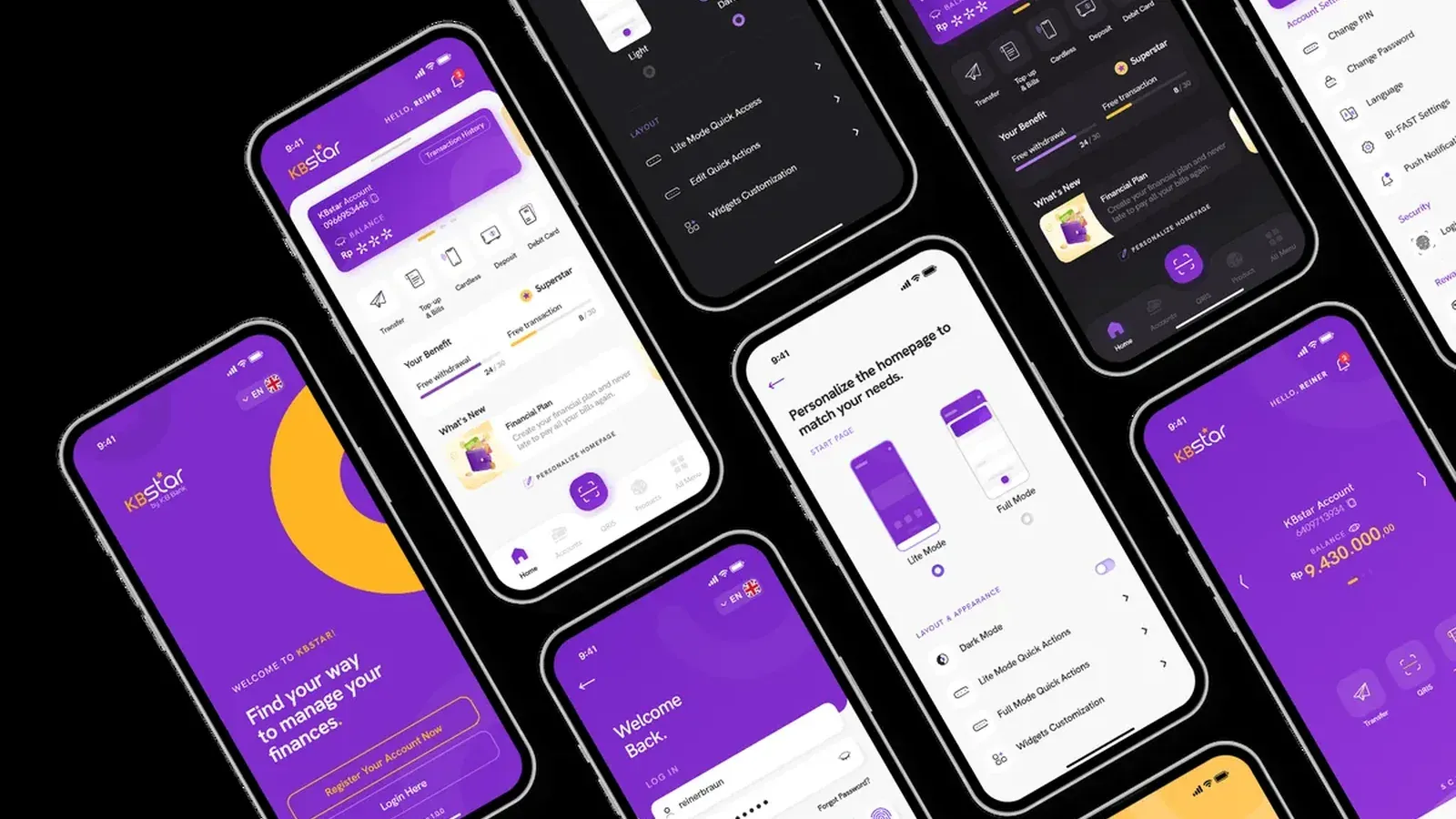
e-KYC onboarding: KBstar Superapp for KB Bank
In the KBstar Superapp project (2021-2024), the main focus was fast account opening. Onboarding takes about 7 minutes entirely within the app, compared with about 15 minutes on the legacy app. Account opening is also 53% faster than the average process at other banks.
The e-KYC process combines ID OCR, a liveness check and AML screening. The app connects to the bank's core and to the OCR, liveness and AML services through APIs. Beyond onboarding, everyday flows were streamlined too: transfers in 5 clicks and 1-click login.
The lesson: fast onboarding is not only about verification technology. It is also about redesigning every step so nothing is repetitive or confusing.
Corporate banking: KBstarbiz for KB Bank
KBstarbiz Corporate Banking (2021-2024) is a web and mobile app for corporate clients. Its features include integrated multi-payment (e-wallet, paylater, QRIS, direct debit and virtual accounts), liquidity management (cash sweeping, cash spreading and sub-accounts), and branch operations such as loans, FX and trade, and payroll.
The goal is to streamline and secure corporate transactions, boosting clients' productivity and cash flow.
The lesson: corporate clients value consolidation. When payments, liquidity and branch services live on one platform, their finance teams don't have to switch between systems.
Loan automation: Maybank Octopus for Maybank Indonesia
Maybank Octopus (2021-2023) is a fully integrated, digitalized loan automation system that simplifies the process from application to approval. This intuitive web app serves the requirements of numerous roles, with one submission system for credit proposals and disbursement.
The lesson: in credit processes, one shared workflow is worth more than many separate tools. When every role works in the same system, the status of each application is clear to everyone.
24×7 operations: Allo Bank
After building a new data center, Allo Bank needed a monitoring team. Digital Center provides 24×7 L1 managed services that monitor all of its systems.
The lesson: digital transformation doesn't end when an app launches. Services that run around the clock need monitoring that runs around the clock too.
Questions for your team
Before starting your next initiative, it helps for product, digital and IT teams to answer these questions together:
- How many steps does a customer need to open an account, and which ones can be removed?
- Do your apps connect to the core through documented APIs, or through integrations that are hard to change?
- Can your corporate clients manage payments and liquidity from one place?
- How many separate tools are used in your lending process, from application to disbursement?
- Who is watching your systems at three in the morning?
How Digital Center helps
Digital Center Indonesia has five Digital Centers in Jakarta, Surabaya, Bandung, Batam and Bali.
Through our Digital Transformation solution, we build web, mobile and tablet apps for banks, including system and API integration with the core and supporting services. Our capabilities cover online and mobile banking, digital payments and wallets, customer support automation, digital cash management, lending and credit management, and treasury and risk management. Engagements can be structured by project fee, milestones and maintenance.
Through Digital Talent, we provide 24×7 managed services to keep your systems monitored once your apps are live.
If you are planning to modernize your banking apps or want to talk through a specific challenge, reach us at marketing@digitalcenter.id.