Digital Transformation
Implementing Odoo ERP: When Your Business Should Move Beyond Spreadsheets
- Published
- Reading Time
- 6 min
- Topics
- Digital Transformation
Many companies grow the same way: sales are recorded in one app, stock in another spreadsheet, and financial reports can only be put together after the team merges data by hand. That works while the business is small, but over time it becomes a bottleneck.
This article covers the signs that your business has outgrown spreadsheets, what an all-in-one ERP like Odoo covers, how an implementation runs, and the principles that keep a project on budget.
Signs your business has outgrown spreadsheets
Spreadsheets and stand-alone apps are not a problem in themselves. The trouble starts when the number of transactions, products and people keeps growing while the data stays scattered. Common signs include:
- The numbers never match. Sales, warehouse and finance each hold their own version of the data, and meetings are spent reconciling figures instead of making decisions.
- Closing the books takes too long. Invoices, expenses and purchases have to be gathered from several sources before a profit and loss report can be prepared.
- Stock levels are unreliable. Items show as available when they are gone, or the other way around, because stock movements are not recorded as they happen.
- Double entry. The same customer data is retyped into the CRM, the sales app and the accounting system.
- Dependence on one person. Only one or two staff members understand the formulas and file structure, so work stops when they are away.
- Expansion feels heavy. Opening a new entity or branch means copying files and processes from scratch.
If several of these sound familiar, it is time to consider a system that brings data and processes into one place.
What an all-in-one ERP like Odoo covers
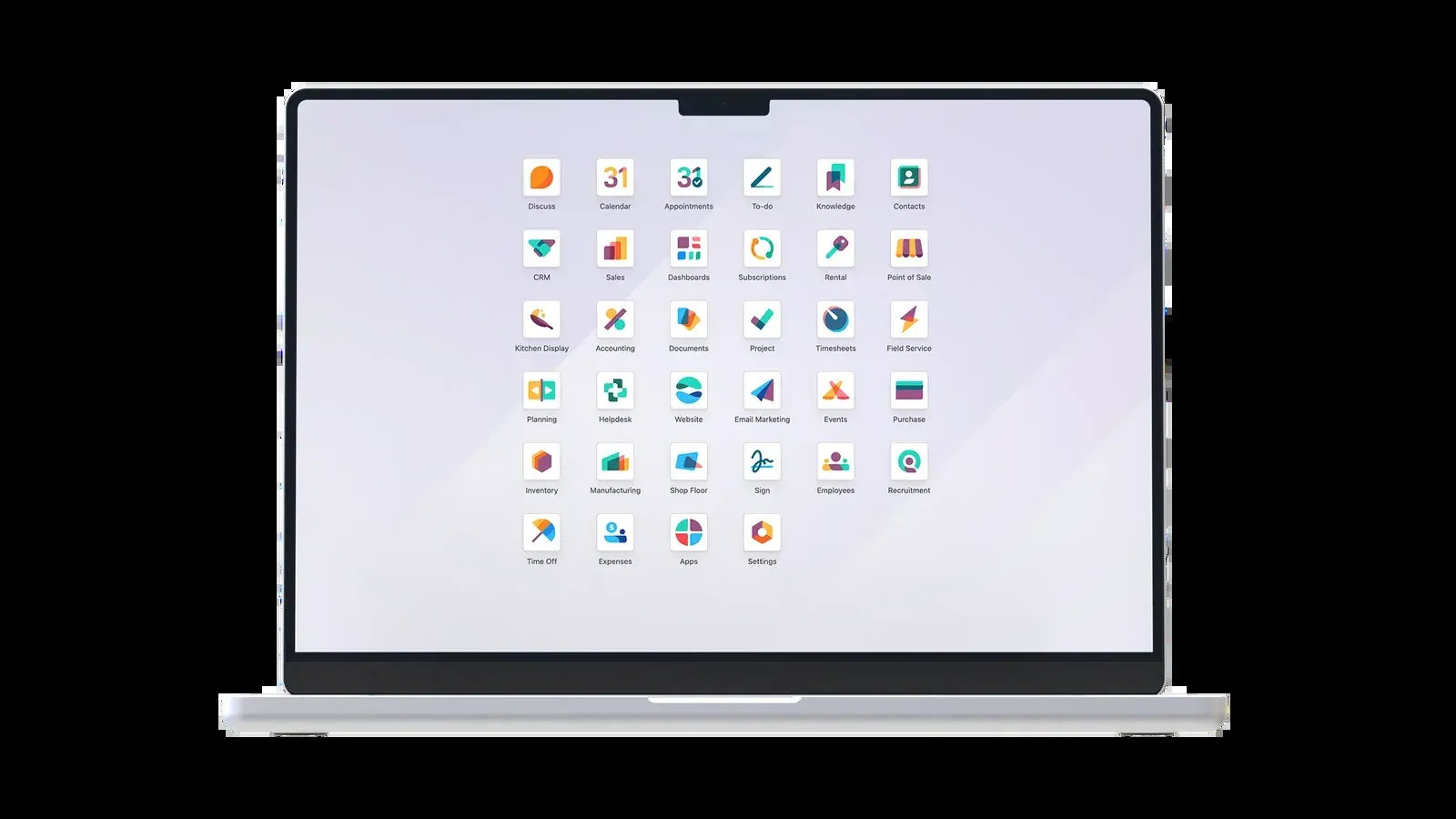
Odoo is all-in-one management software. Instead of separate apps for accounting, CRM, sales, inventory, manufacturing, purchasing, marketing, eCommerce and website building, everything runs in one solution with connected data. Its apps are grouped as follows:
- Sales: CRM, Sales, Subscription and POS.
- Finance: Invoicing, Accounting, Expense, Consolidation, plus Sign, Documents and Approval.
- Operations: Inventory, Timesheet, Project, Purchase, Helpdesk, Field Service and Rental.
- Human resources: Planning, Employees, Recruitment, Referral, Appraisal and Time Off.
- Manufacturing: Manufacturing, Quality, Maintenance and PLM.
- Marketing: Social Marketing, SMS Marketing, Email Marketing, Events and Survey.
- Website: Website Builder, eCommerce, Blog, Forum, Appointments, eLearning and Livechat.
- Customization and productivity: Studio, Discuss, Approvals, WhatsApp, VOIP and Knowledge.
You do not need to use everything at once. Most companies start with the most pressing modules, such as sales, inventory and accounting, and add others as their needs grow.
Take Mambucha, a producer of kombucha and other products made with SCOBY as a raw material. It uses the Odoo manufacturing module to track production, and every process feeds directly into accounting. The system is set up for multiple companies, with menu and record access restricted by user level.
How an Odoo implementation runs
A good implementation does not start with installation. It starts with understanding how the business works. A typical flow:
- Project qualification. Understanding the size of the business, its goals and the areas that most need improvement.
- General requirements. Mapping current processes and the relevant modules.
- Quotation. Scope, stages and cost are agreed up front.
- Kick-off and planning. Setting the team, schedule and owners on both sides.
- Implementation. Gap analysis (comparing your processes with standard features), design and customization, user acceptance testing (UAT) and user training.
- Go live. The system goes into daily operation, followed by support and maintenance.
Gap analysis is a decisive stage. This is where you decide which parts can run on standard features and which genuinely need customization. Involve key users from every department from this stage onward, because they know best the exceptions and working habits that never made it into written procedures.
Raja Impex, a global retail exporter managing more than 20,000 SKUs from Indonesia to international markets, is an example of well-targeted customization. Odoo was integrated across sales, inventory, accounting, purchasing, expenses and HR. Its key challenge was solved by customizing the sales module to calculate loading efficiency for 20 ft and 40 ft containers in real time as items are added to an order.
Principles that keep an implementation on budget
ERP projects often overrun because of too many customizations. Three principles help keep cost and time under control:
- As standard as possible. Odoo's standard features already cover many common business practices. Customize only where a process truly sets your business apart, like the container calculation above.
- As fast as possible. Start with the core modules, put them to use quickly, then build out in stages. Feedback from real users is worth more than a design that sits on paper too long.
- Affordable. A clear scope from the quotation stage, milestone-based payments and maintenance after go-live make costs easier to plan.
On your side, prepare an internal owner with the time and authority to make decisions, clean master data, and a willingness to simplify processes that became complicated only because of spreadsheet limitations.
Integrating with systems you already run
Adopting an ERP does not always mean replacing every system. If you already have an internal application that works well, Odoo can run alongside it and exchange data through an API.
Delovery took this approach. Data from its internal application, which is not built on Odoo, is pulled into Odoo through an API to create CRM opportunities without replacing the existing system. Odoo is deployed as a separate system, and the data flows on to Sales, Purchase and other modules, giving management reports on sales and purchaser performance.
Odoo can also serve as a foundation for growth plans. Bio V Global, a Malaysian wellness company preparing for an IPO within three years, uses an Odoo financial system to record core product sales and multi-round investor transactions, from co-founder and angel rounds up to the IPO, ahead of a planned 2026 expansion into Indonesia. A multi-company setup provides balance sheet, trial balance and profit and loss reports, while its company profile website is built on the Odoo website builder, with every form submission flowing straight into the CRM.
How Digital Center helps
Digital Center Indonesia has five Digital Centers in Jakarta, Surabaya, Bandung, Batam and Bali. Odoo ERP and CRM are part of our Digital Transformation solution, alongside web, mobile and tablet app development and system and API integration.
Our transformation work spans finance, HR, manufacturing, supply chain, project management, sales, marketing, customer service, field service and project service automation. Engagements run on a project fee, milestones and maintenance, guided by three principles: as standard as possible, as fast as possible, and affordable.
If you are starting to feel the limits of spreadsheets and stand-alone apps, let's talk about your business needs at marketing@digitalcenter.id.