
/
Digital Transformation
Successful digital transformation requires prioritizing the right automation initiatives with a clear framework, rather than chasing urgent requests, to ensure execution delivers measurable and lasting impact.
Automation ideas are easy to collect and hard to choose. Every department has a list: finance wants faster approvals, operations wants fewer spreadsheets, procurement wants tighter control, and leadership wants dashboards that can be trusted. When everything feels urgent, teams either automate the loudest request or try to automate everything at once. Both approaches usually create disappointment.
A stronger Digital Transformation plan starts with prioritization. When you rank automation opportunities using a clear framework, you stop guessing. You also avoid the common trap where tools launch successfully but workflow performance barely changes. McKinsey notes that 70% of transformations fail, often because execution breaks down and impact is not sustained.
This article gives you a practical framework to prioritize what to automate, plus real use cases, measurable KPIs, and pitfalls to avoid.
The real problem is not a lack of ideas, it is a lack of focus
Most organizations already know what hurts. The issue is deciding what to fix first, with limited time and attention.
Symptoms you are prioritizing the wrong way
The backlog is huge, but nothing ships end-to-end
Automation is delivered, yet cycle time stays the same
Teams keep a “shadow spreadsheet” because the system feels incomplete
Dashboards exist, but leaders still ask for manual updates
The same exceptions happen repeatedly because root causes never get addressed
Why this matters in Digital Transformation
Digital Transformation spending is growing fast, which also raises the bar for speed and execution. IDC forecasts worldwide DX spending to reach almost $4 trillion by 2027.
You do not need to match that scale. You do need a method that keeps your roadmap practical.
The Digital Transformation automation prioritization framework

Here is a simple framework that works well in real companies. It prioritizes automation using two lenses:
Business Value (does it move meaningful numbers?)
Feasibility (can you implement it cleanly and safely?)
This aligns with public-sector automation guidance that starts with identifying, prioritizing, and capturing automation opportunities in a pipeline.
Step 1: Define your “automation unit” clearly
Do not start with “automate procurement” or “automate finance.” Start with a single workflow slice that can be measured end-to-end.
Good examples:
Purchase Request submission → approval → PO creation
Vendor onboarding → document checks → approval to transact
Invoice received → validation → approval → payment release
Customer request intake → routing → resolution → closure
Bad examples:
“Make operations digital”
“Use AI to improve everything”
“Automate reporting” (without defining source systems and rules)
Workflow snapshot (easy to scan):

Step 2: Score Business Value using 5 criteria
Score each from 1–5.
Volume: How often does it happen?
Delay cost: What does it block (revenue, delivery, compliance)?
Error cost: How expensive are mistakes and rework?
Customer impact: Does it affect response time or service quality?
Control impact: Does it strengthen audit trail and governance?
Tip: Put a number next to the pain. If you cannot quantify the impact, it is usually not ready for early automation.
Step 3: Score Feasibility using 5 criteria
Score each from 1–5.
Rule clarity: Can you describe the steps and decisions plainly?
Process stability: Does the workflow change weekly, or is it consistent?
Data readiness: Are required fields structured and available?
Integration complexity: How many systems must connect?
Exception rate: How often does the process go off-script?
This “value + feasibility” approach is also recommended as a way to qualify opportunities and maximize quick wins in automation programs.
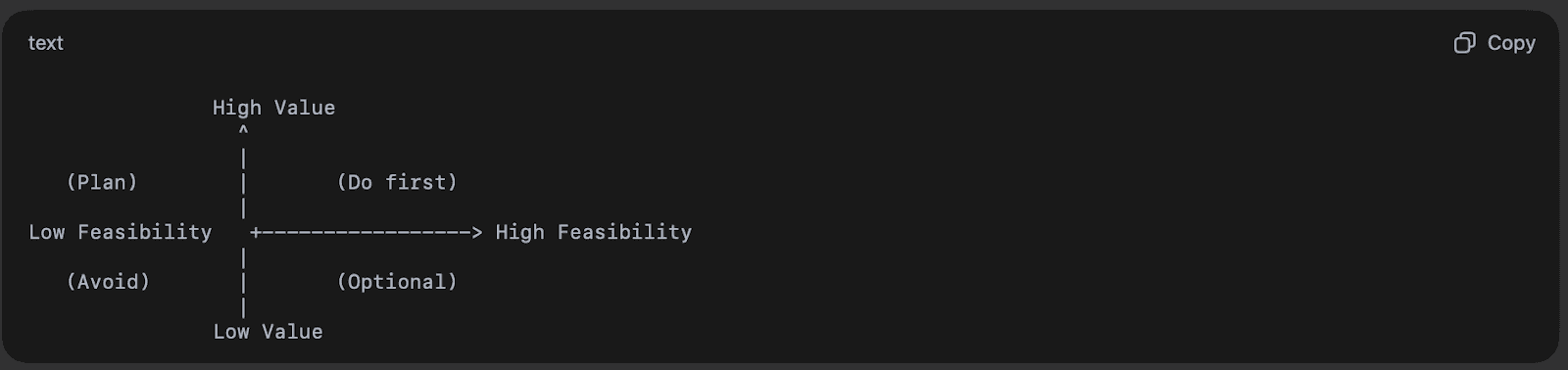
Step 4: Use a 2x2 matrix to pick winners fast
Plot each workflow as Value vs Feasibility.
High Value + High Feasibility
→ Do these first. They build momentum and credibility.
High Value + Low Feasibility
→ Break into smaller slices or fix data/process first.
Low Value + High Feasibility
→ Consider only if it removes pain for a critical team, or if it is a prerequisite.
Low Value + Low Feasibility
→ Park it. Do not let it consume roadmap oxygen.
Quick visual:
Applying the framework to real workflows
Below are three common use cases and how the scoring typically plays out.
Use case 1: Procurement approvals and PR-to-PO flow
Why it often ranks high:
High volume
Clear approval steps
Strong governance benefit
Easy to measure with cycle time
Deloitte notes that digital solutions can reduce order approval time by 50% in procurement operations.
What to automate first (practical sequence):
Standard request form with required fields
Approval routing with SLA reminders and escalation
PO creation and status tracking
Vendor onboarding checklist and document validation
Spend visibility dashboard (after data is stable)
KPIs to track weekly:
Approval cycle time (created → approved)
Rework rate (requests returned for missing info)
SLA compliance
Percentage processed inside the system (adoption)
Use case 2: Invoice approval and exception handling
Why it often ranks high:
Errors are costly
Exceptions create delays
Finance teams lose time on manual validation
What to automate first:
Standardize validation rules (required invoice fields, PO matching rules)
Route exceptions to the right owner with reason codes
Create a dashboard for “stuck items” by owner and SLA
KPIs:
Days payable outstanding (if relevant)
Invoice processing cycle time
Exception rate by vendor/category
Manual touchpoints per invoice
Use case 3: Customer request routing with service SLAs
Why it can rank high:
Direct customer experience impact
High volume
Clear SLA metrics
What to automate first:
Structured intake (form, ticket, or portal)
Routing based on category and urgency
SLA reminders and escalation
Resolution templates and closure codes
KPIs:
First response time
Resolution time
Reopen rate
Customer satisfaction (if measured)
If you have a long automation wish list and want to pick the right first moves, Digitalcenter can run a Free Automation Assessment. You will receive a prioritized shortlist using a value and feasibility score, plus a phased plan you can execute without inflating scope.
Three ways companies prioritize automation
Not every organization needs the same method. Here are three workable approaches.
Option A: Value vs feasibility scoring (best default)
Use when:
you need a transparent method
stakeholders disagree on priorities
you want quick wins without gambling
Pros: simple, defensible, fast
Cons: needs basic baseline metrics to be credible
Option B: Bottleneck-first prioritization (best for speed)
Use when:
one workflow blocks many others
the pain is obvious and daily
Examples:
approvals that delay purchasing
onboarding that blocks operations
reporting that consumes leadership time
Pros: very practical, fast momentum
Cons: can ignore strategic opportunities if used alone
Option C: Risk and compliance-first (best for regulated orgs)
Use when:
audit trails and traceability are urgent
errors carry high penalties
Examples:
procurement approvals
financial controls
access management and approvals
Pros: reduces exposure quickly
Cons: ROI may feel indirect unless KPIs are defined clearly
Proof points that make Digital Transformation measurable
If you want buy-in, avoid vague targets like “become more digital.” Track outcomes that reflect real operational change.
A tight KPI set that works well in early phases
Cycle time: request created → completed
Work in progress: how many items stuck and where
Rework rate: returns due to missing info or wrong routing
SLA compliance: percent meeting target times
Adoption: percent processed in the new workflow
Data quality: missing mandatory fields, duplicates, inconsistent codes
McKinsey also emphasizes that sustaining impact matters, not just launching initiatives.
Common mistakes when prioritizing what to automate
These issues show up across industries and company sizes.
Mistake 1: Automating workflows nobody agrees on
If approval rules are unclear, automation will amplify confusion. Lock the rules first, then automate.
Mistake 2: Choosing flashy projects with weak baselines
If you cannot measure “before,” you will struggle to prove “after.” Start where the baseline is easy.
Mistake 3: Building dashboards before data rules exist
Dashboards do not fix data quality. Define required fields, validation rules, and ownership first.
Mistake 4: Leaving the spreadsheet escape hatch open
If teams can bypass the process, they will. Keep exceptions, but log them so the audit trail stays intact.
Conclusion
Digital Transformation becomes far more manageable when automation decisions are made with a consistent framework. Score value, score feasibility, pick the high-impact quick wins, and measure performance weekly. That is how you build momentum without turning the roadmap into a never-ending program.
Ready to prioritize your automation roadmap with real numbers? Talk to a Digitalcenter Digital Transformation expert and request a Free Automation Assessment. We will help you select the best first workflows, define KPIs, and plan phased delivery that teams actually adopt.


Let’s keep in touch.
Discover more about high-performance web design. Follow us on LinkedIn, Instagram and Behance.